

Dry ice for cold caps during chemotherapy: how much to order and how to handle it safely
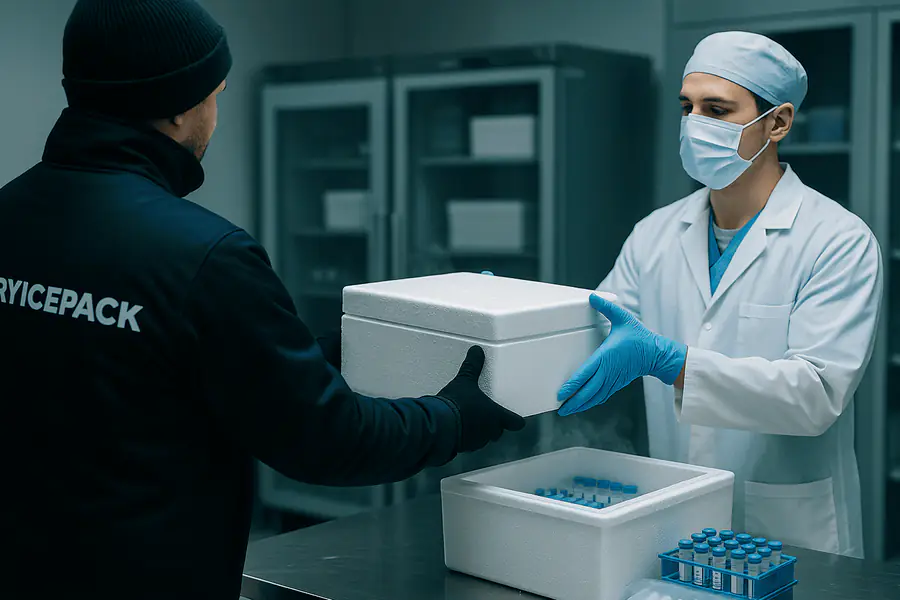
In short: dry ice keeps cold caps cold in a cool box during the session. As a guide, our orders for cold caps were around 5 kg per session. The right amount depends on your cold cap system and how long the session lasts.
Before you read on: we aren’t healthcare professionals and we don’t give medical advice here. This guide only explains how to order, store and handle dry ice. Whether scalp cooling is right for you, and how to do it, is for your oncology team to decide. Your cold cap system comes with its own instructions (temperature, when to change caps): those instructions always come first.
What is dry ice used for with cold caps?
If your cold cap system is cooled with dry ice, the caps wait their turn in a cool box with dry ice and are swapped during the session. That is the dry ice’s only job: keeping the caps cold. If your cap instructions don’t mention dry ice, check with the manufacturer before using it.
How to pack the caps in the cool box, how cold they should be when you put them on and how often to change them are all set out in the manufacturer’s instructions. If in doubt, ask the manufacturer or your oncology team.
How much dry ice do I need per session?
It depends on the cap system, how many caps you use and how long the session lasts. First, check whether the manufacturer gives a quantity.
As a guide, the orders we have supplied for cold caps were around 5 kg per session. With our 3, 10, 15 and 20 kg packs, that works out like this:
| For | What to order |
|---|---|
| One session (guide: about 5 kg) | 2 boxes of 3 kg (6 kg) or 1 pack of 10 kg |
| Sessions on consecutive days | Tell us how many sessions and we’ll tell you how much to order |
It’s a guide, not a rule. The price per kilo goes down with each pack: the 10 kg pack costs less than two 3 kg boxes and gives you more margin. For several days in a row, message us before you order and we’ll work it out with you.
3 mm or 16 mm?
16 mm nuggets have more mass per piece and last longer. 3 mm pellets cool faster and fill gaps better. If your cap instructions specify a format, use that one.
How do I order it so it arrives in time?
You can order in advance and choose the delivery day at checkout.
- Order before 12:00 (Spanish time), Monday to Thursday: it arrives the next morning, anywhere in mainland Spain.
- Order before 12:00 on Friday: it arrives on Saturday depending on your area, with an €11.74 surcharge (VAT included). Otherwise, on Tuesday.
- No deliveries on Sunday or Monday. No orders leave on public holidays: at checkout, you only see the days you can choose.
- Deliveries are in the morning, but the exact time depends on the courier’s route. If your session is first thing, order it for the day before. Dry ice sublimates over time: keep the delivery box closed until you’re ready to load the cool box and, if you’re not sure how many kilos to order, message us.
What if my session is on a Monday?
There are no deliveries on Mondays. You have two options:
- Saturday delivery. Order before 12:00 on Friday, if your area has Saturday delivery (€11.74 surcharge, VAT included). The ice will spend the weekend in its box: message us before you order and we’ll work out the kilos.
- Collection in Mataró on the Monday itself. From our warehouse (Camí Ca La Madrona 19 D), Monday to Saturday, including public holidays. Choose Monday at checkout and we’ll confirm the time by phone or WhatsApp; if your session is early, tell us when you order. There’s no delivery charge and the price is a round figure with VAT included: 3 kg for €35 and 10 kg for €60. You pay in cash, with the exact amount: we can’t give change.
How do I handle it safely?
Dry ice is at −78.5 °C. These rules apply at home, in the car and at the hospital:
- Thermal gloves and tongs. Never touch it with bare hands: it causes a cold burn in seconds.
- A cap that has touched dry ice can end up much colder than the manufacturer specifies and burn the skin. Prepare the cool box as its instructions say, remove any pieces or frost and check the temperature before each change.
- Nothing airtight. As it sublimates, the gas builds up pressure and can burst a sealed container. Use a cool box that doesn’t seal airtight; never bottles or food tubs.
- A ventilated space. CO2 displaces oxygen in enclosed spaces. Before your first session, ask the hospital whether you can bring the cool box with dry ice and where you can open it.
- The night before, in its box. With the lid on but not sealed, in a ventilated room where nobody is sleeping. Never in the freezer or the fridge at home.
- In the car, never in the passenger compartment: in the boot, with ventilation.
- Out of reach of children and pets, at home too while you wait for the session.
- It must not be eaten or drunk. Never put a pellet in a drink.
- Leftover ice: let it sublimate outdoors, out of everyone’s reach. Never down the sink, the toilet or into a closed bin.
If there’s a cold burn:
- At the hospital: tell the staff first. Then warm the area with lukewarm water, not hot, and don’t rub it.
- At home: warm the area with lukewarm water, not hot, and don’t rub it. If there are blisters or the skin changes colour, see a doctor.
What do I take on the day of the session?
- The cool box with the caps and the dry ice, closed but not airtight.
- Thermal gloves and tongs. If someone helps you change caps, they should wear gloves too.
- Whatever your cold cap system’s instructions ask for.
Who can I talk to if I have questions?
Call us on +34 936 73 76 41, message us on WhatsApp at +34 686 980 471 or email info@dryicepack.es, Monday to Friday, 9:00–18:00. We’ll help you with the kilos and the dates. Questions about your treatment are for your oncology team.