

Is it dangerous to breathe in the ‘smoke’?
What you see isn’t smoke: it’s water vapour from the air, condensed by the cold, together with CO₂. In a ventilated space it’s harmless; the risk comes in small, closed spaces.
It isn’t toxic or flammable, but it must never be eaten or drunk: never put a pellet in a drink. Handling it has three risks, and all three can be avoided: it burns the skin because it’s at −78.5 °C, in a closed space the CO₂ displaces oxygen, and in an airtight container the pressure can burst it.
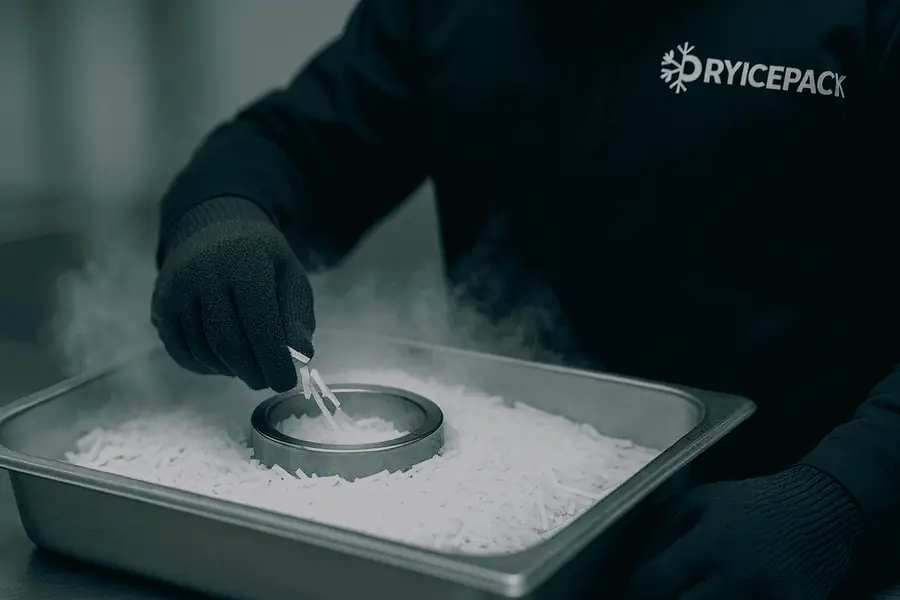
Warm the area with lukewarm water, not hot, and don’t rub it. If there are blisters or the skin changes colour, see a doctor.
Get into the fresh air and ventilate the space. If it doesn’t improve or someone loses consciousness, call 112.
Call 112 or the Poison Information Service (Spain) on 91 562 04 20.
The document your health and safety team, quality team or auditors will ask for: identification, hazards, first aid, handling, protection and transport.
Download the sheetPDF · Spanish
What you see isn’t smoke: it’s water vapour from the air, condensed by the cold, together with CO₂. In a ventilated space it’s harmless; the risk comes in small, closed spaces.
For the fog effect, yes, with a double container: the dry ice goes in the outer container and the drink in another. Never a pellet inside a glass someone is going to drink from.
Dry ice doesn’t explode. What can burst is an airtight container, because of the gas pressure. That’s why the box is never taped shut.
Yes, if an adult handles it and you keep it out of reach of children and pets. If you’re making fog, put the dry ice where no guest can touch it.
Never in the passenger compartment: in the boot, inside its box and with ventilation, whatever the quantity.
Order now and you’ll have it on the morning of Tuesday 20 October